When we planned our trip to this part of Italy, we wanted to experience Pompeii, Herculaneum and Mount Vesuvius together rather than treating Pompeii as a stand-alone attraction. Hiking Mount Vesuvius to the crater, walking through the remarkably well-preserved Herculaneum ruins and exploring the much larger Pompeii archaeological site gave us three very different perspectives on the eruption of AD 79.
The contrast between the sites was one of the most interesting parts of our visit. Herculaneum felt compact and remarkably intact, while the scale of the Pompeii ruins was much greater than we expected. Hiring a private guide in Pompeii also made a significant difference, helping us understand what we were seeing and how people actually lived in the ancient Roman city.
In this article, we share our experience hiking Mount Vesuvius, visiting Herculaneum and taking a private tour of Pompeii, along with practical advice on transportation, the physical demands of the Mount Vesuvius hike, where we stayed in Ercolano and what we would do differently.
We travelled with our kids, who were 10 and 12 at the time, but the focus here is on what adults can expect when visiting these three sites.
This post may contain compensated links.
Why We Visited Pompeii, Herculaneum and Mount Vesuvius
Pompeii was one of the places we most wanted to visit during our trip to Italy. Once we began looking at the surrounding area, we realized we could combine Pompeii with Mount Vesuvius, Herculaneum and a trip to the nearby island of Ischia.
That turned out to be an excellent way to experience the area. Hiking Mount Vesuvius first gave us a very different perspective when we later saw the volcano looming above the archaeological sites. Herculaneum and Pompeii then gave us two very different but complementary glimpses of Roman life before the eruption.
Hiking Mount Vesuvius
Our first experience in the Pompeii area was climbing Mount Vesuvius. We hike frequently when we travel, but this one was unique because of the history attached to the volcano.
Mount Vesuvius buried Pompeii and Herculaneum during its eruption in AD 79. It has not erupted since 1944, but it is still considered an active volcano.
Getting to Vesuvius National Park
We stayed in Ercolano and booked a package with Vesuvius Express that included bus transportation to Vesuvius National Park and timed entry tickets. Its departure point was conveniently located near our hotel in Ercolano.
Similar tour packages were available from Naples, Pompeii and Sorrento, but staying in Ercolano made the logistics particularly easy for us. Not only was it easy to hike Mount Vesuvius from here, it was close to the ferry port to get to Ischia.
Regardless of how you get to Mount Vesuvius National Park, be aware that timed entry tickets must be purchased in advance. You cannot simply show up and buy a ticket.
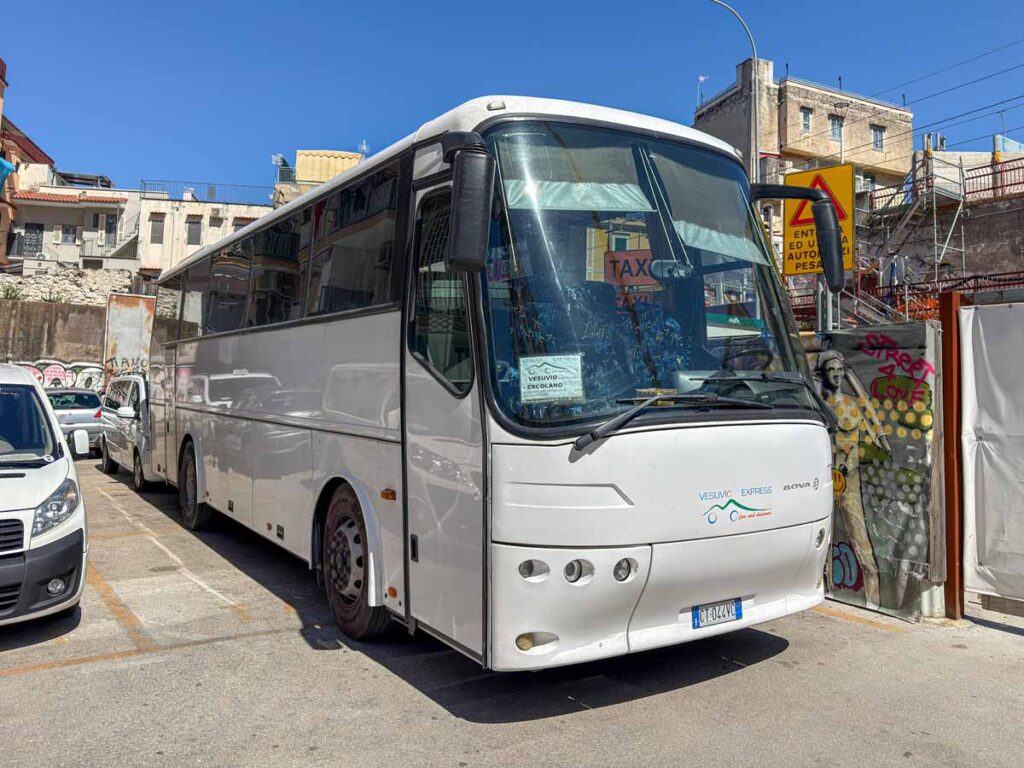
Hiking the Il Gran Cono Trail
The main visitor route up Mount Vesuvius is the Il Gran Cono Trail. It begins at the park entrance at roughly 1,000 metres (3,280 feet) above sea level.
The trail is wide and dusty, with much of the walking on crushed volcanic rock. There is very little shade, and the trail starts climbing immediately. The uphill continues all the way to the crater. We found it reasonably steep, but the wide trail and frequent viewpoints made it easy to stop for breaks when needed.
There are several viewpoints as you climb, which also provide convenient places to stop for a short break. The first viewpoints look out over Naples, the Gulf of Naples and Ischia, with the views improving as you gain elevation on a clear day.
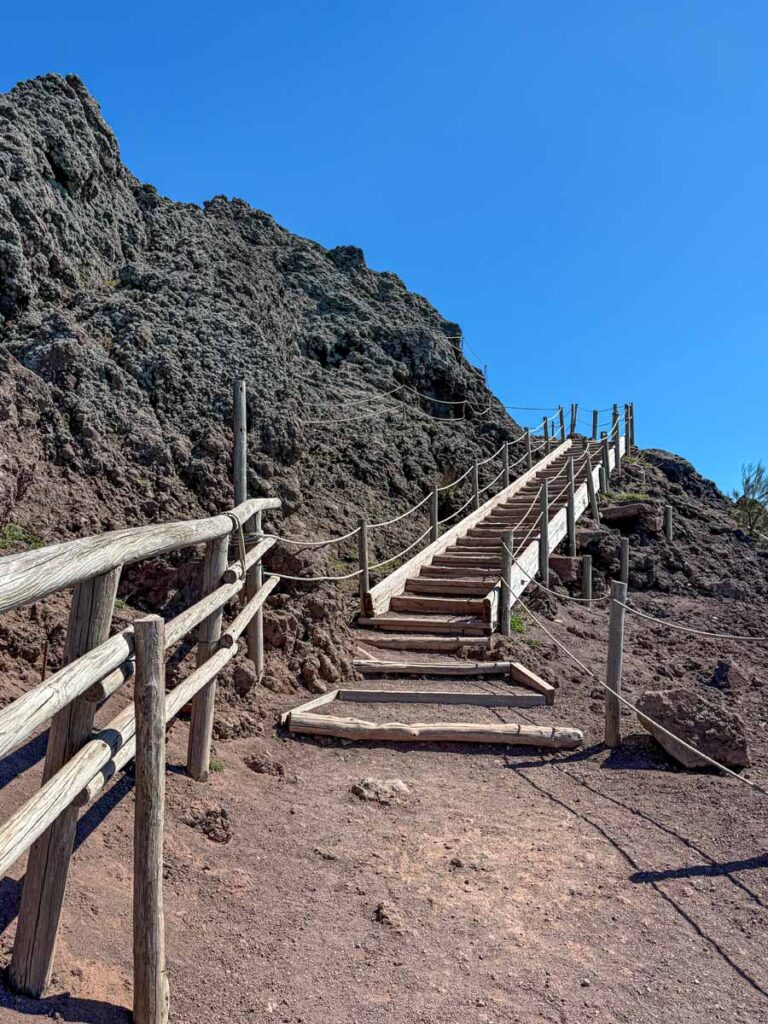
Reaching the Mount Vesuvius Crater
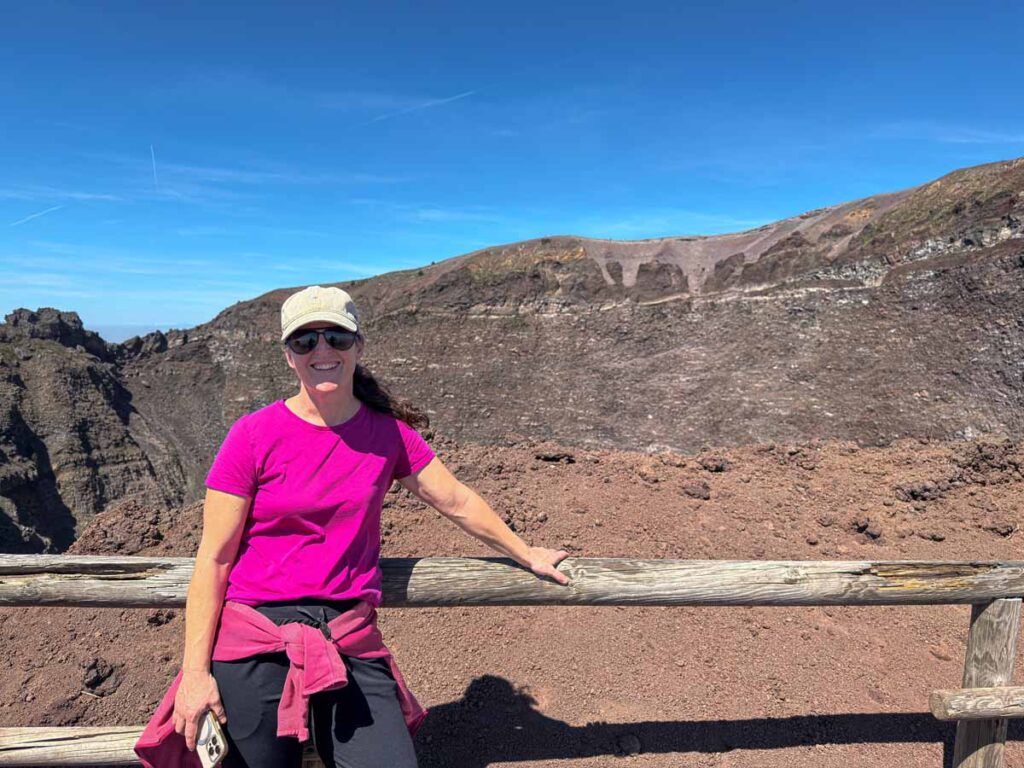
You reach the rim of the crater after approximately 1 km (0.6 miles) of uphill walking. This first viewpoint was the busiest, so we found it better to continue farther along the trail, where it was less crowded and easier to get a good view.
The trail continues for another 700 m (2,300 feet) along the top of Mount Vesuvius, with several more viewpoints into the crater. There are also views toward the Pompeii area, the Sorrento Peninsula and Capri.
The crater itself was impressive, and we could see active steam vents along its inner walls. The official trail reaches a maximum altitude of about 1,175 metres (3,850 feet), and the entire route is roughly 4 km (2.5 miles).
Starting our visit this way made the history of Pompeii feel much more tangible. Standing at the crater before visiting Herculaneum and Pompeii gave us a much stronger sense of the volcano that shaped both places.
Visiting Herculaneum
Herculaneum was particularly convenient from where we stayed in Ercolano. The archaeological site was only a five-minute walk from our Ercolano hotel.
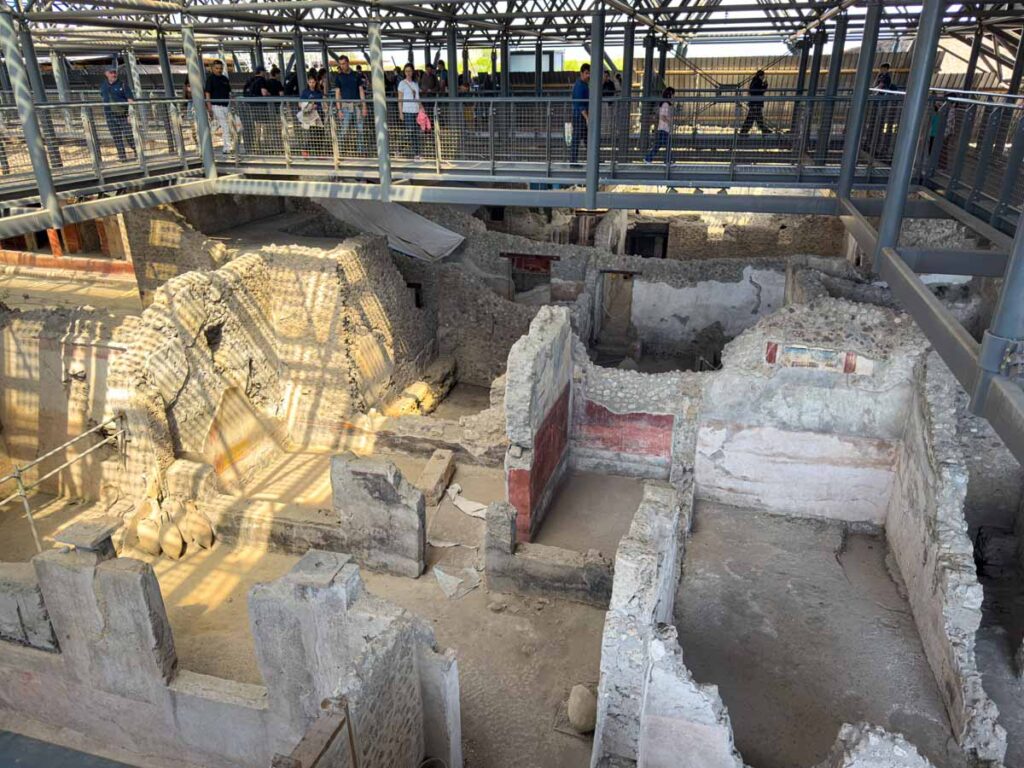
Before entering the ruins, we walked along an elevated walkway with excellent views over the ancient town. From there, a long spiral walkway led down into the site, giving us another look at Herculaneum from above. We enjoyed having that overview before walking through the streets because it helped us understand the layout.
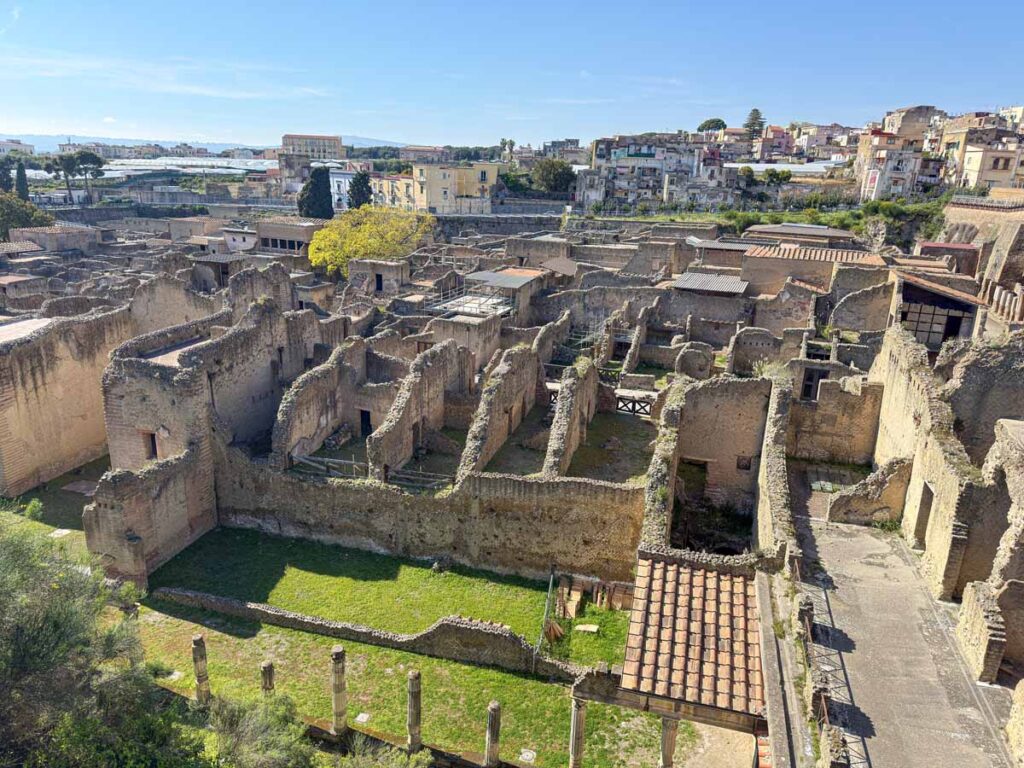
Herculaneum is less well known than Pompeii, but we were impressed by how well preserved it was. In many places we could still see details such as paintings and tile work, which helped us to imagine daily life in the town nearly 2,000 years ago.
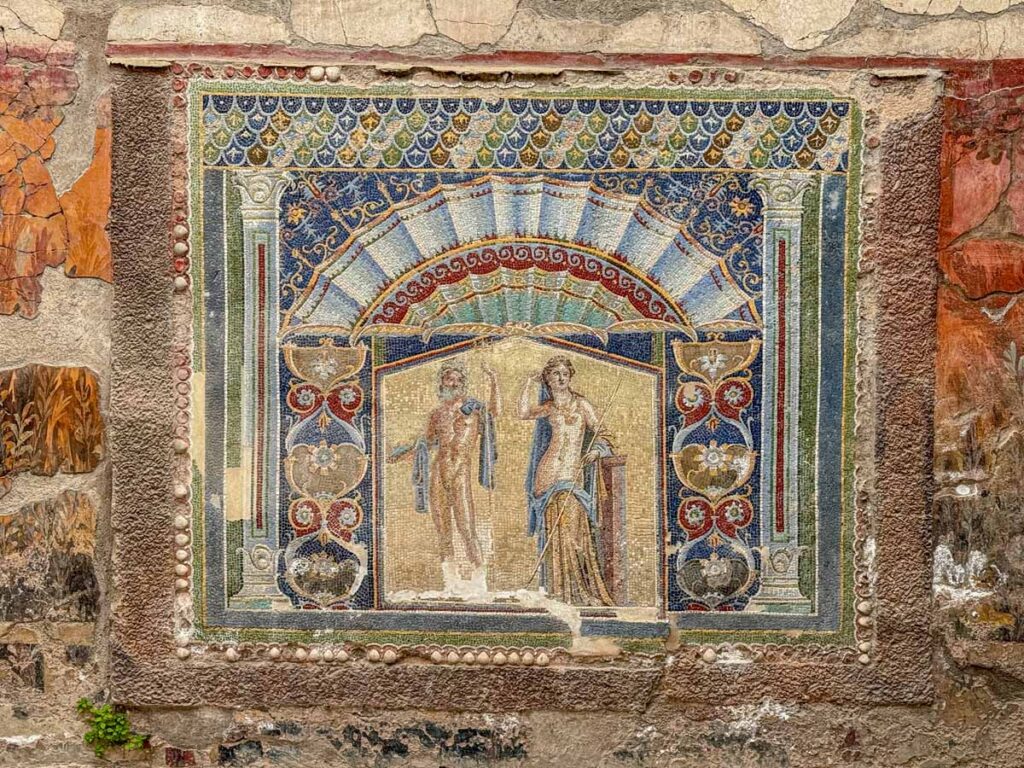
We visited Herculaneum without a guide, and we regret it. There were hardly any information signs throughout the site, and we often weren’t sure what we were looking at. An audio tour or guide would have brought much more of Herculaneum’s story to life.
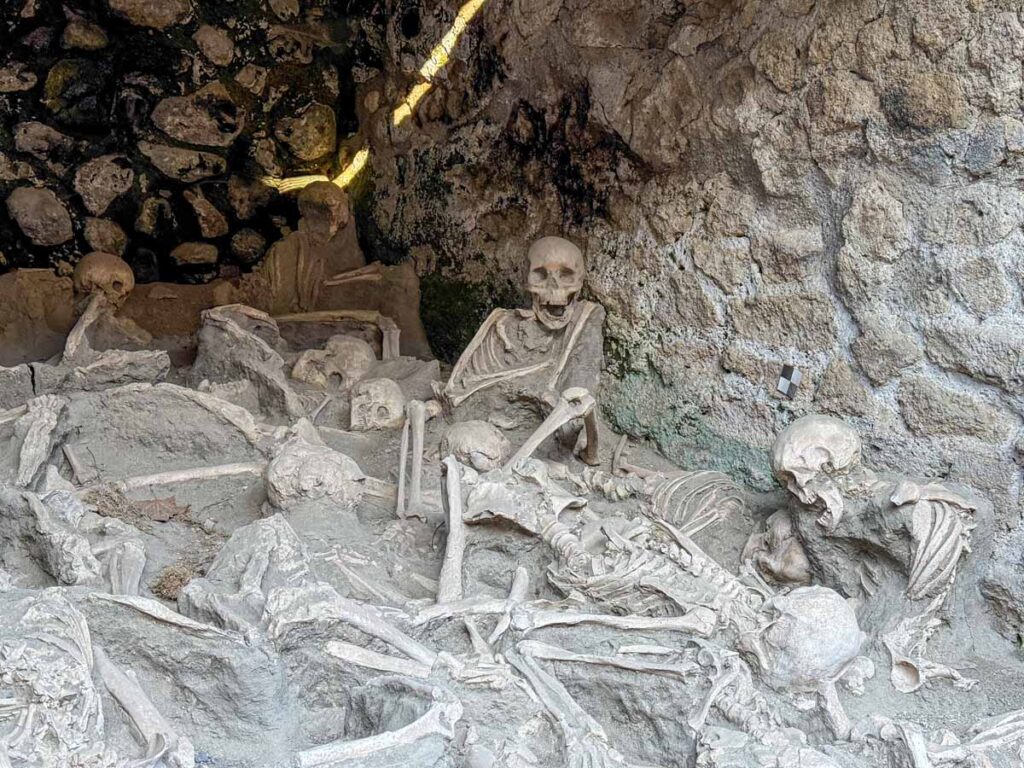
One of the most sobering parts of Herculaneum was seeing the skeletons in buildings near the ancient shoreline. Around 300 people had gathered in vaulted spaces near the beach, likely hoping to be rescued by sea. Seeing their remains was a powerful reminder that Herculaneum was not simply an archaeological site, but a town filled with people whose lives ended during the eruption.
Visiting Pompeii
Pompeii was the main reason we had come to the area, and one of the first things that surprised us was its size. We had imagined something closer to a small village and quickly realized the ancient city was much larger than we had expected.
Because Pompeii was such an important part of our trip, we paid for a private two-hour tour. In our case, that money was very well spent. Without our guide, we would have felt completely lost.
Why We Chose a Private Tour of Pompeii
Our guide, Daniela, met us precisely on time and began by asking about our interests. She then tailored the tour so we could see the parts of Pompeii that interested us most while still giving us a comprehensive introduction to the city.
The value of the guide became even clearer once we saw how extensive Pompeii was. Rather than simply wandering among ruins, we understood what we were seeing and how the individual buildings and streets fit into the larger city.
Gladiator School and the Large Theatre
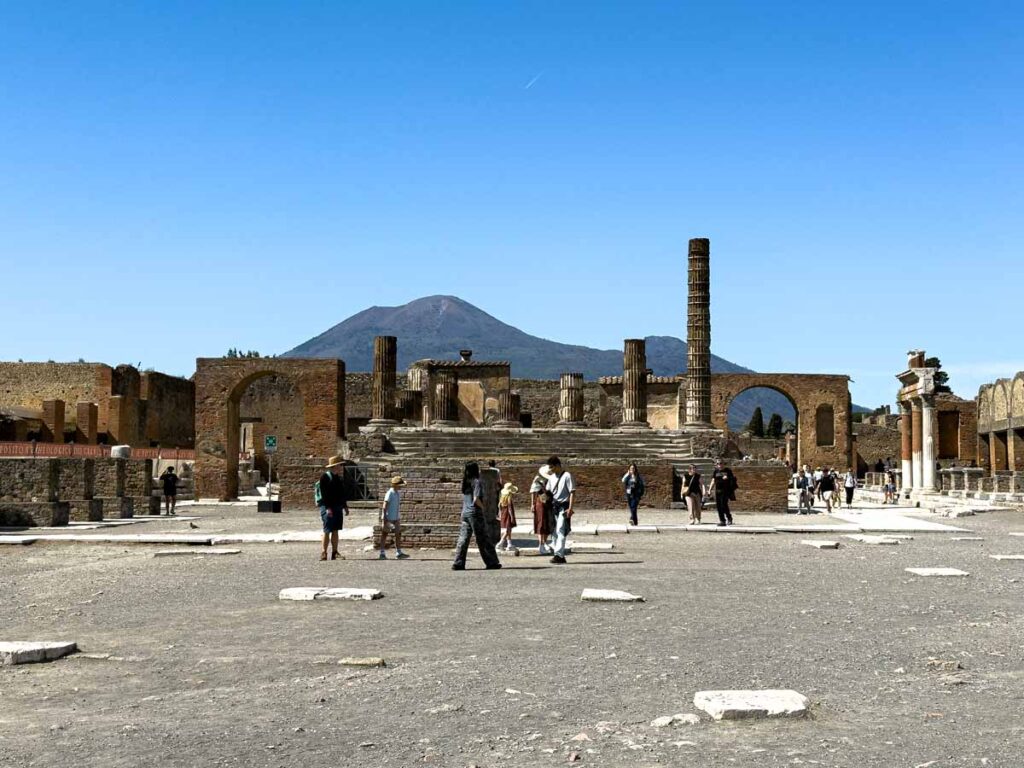
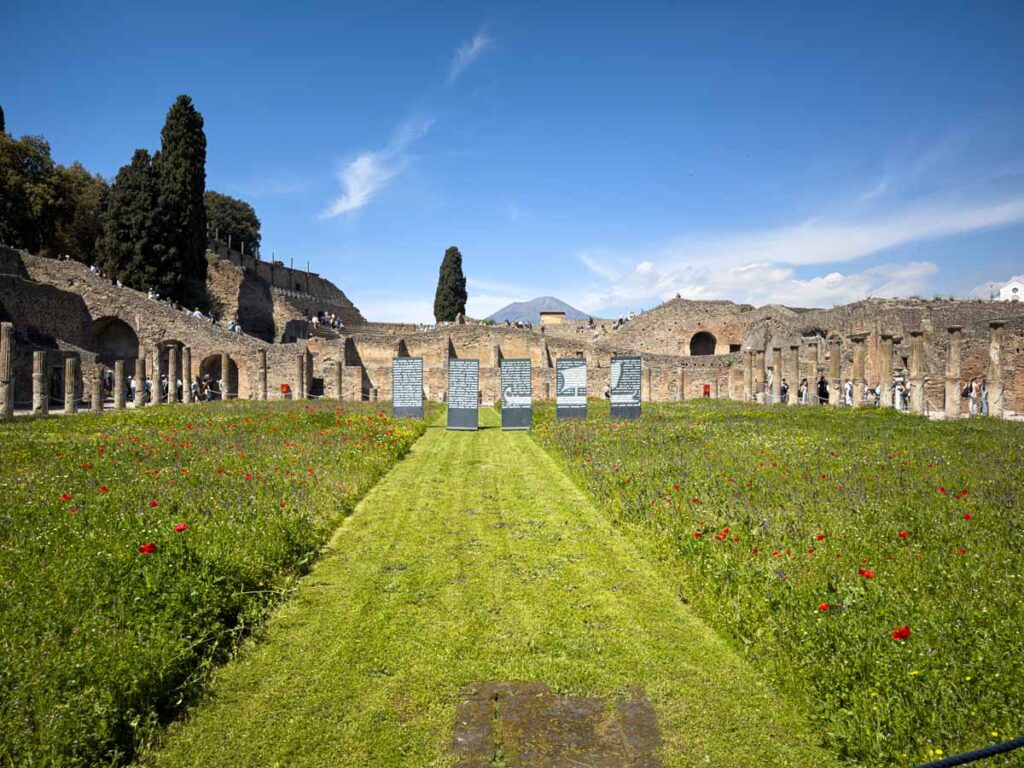
We began at the gladiator school, a large square surrounded by Roman pillars, with a field of poppies in its centre. From there, Mount Vesuvius was visible in the distance, an unsettling backdrop once you understand what happened here.
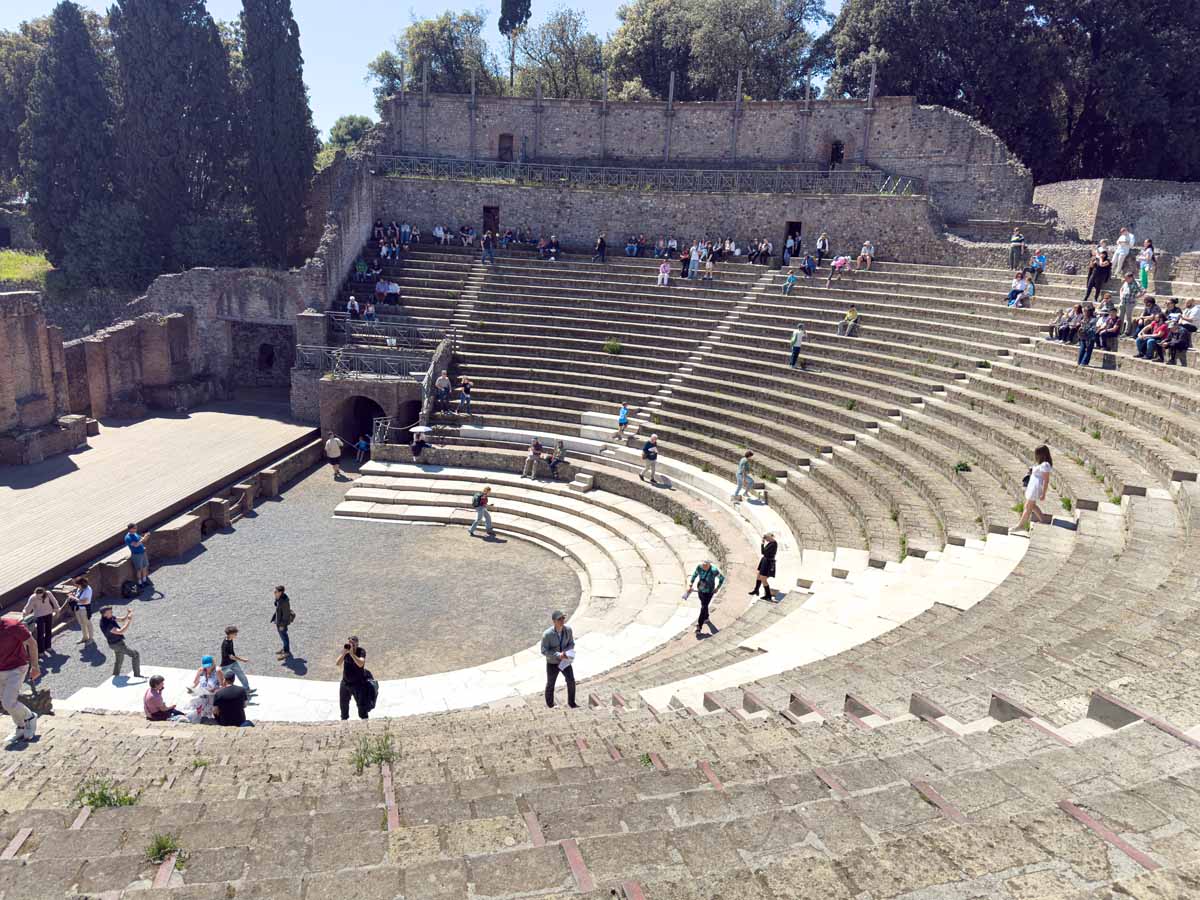
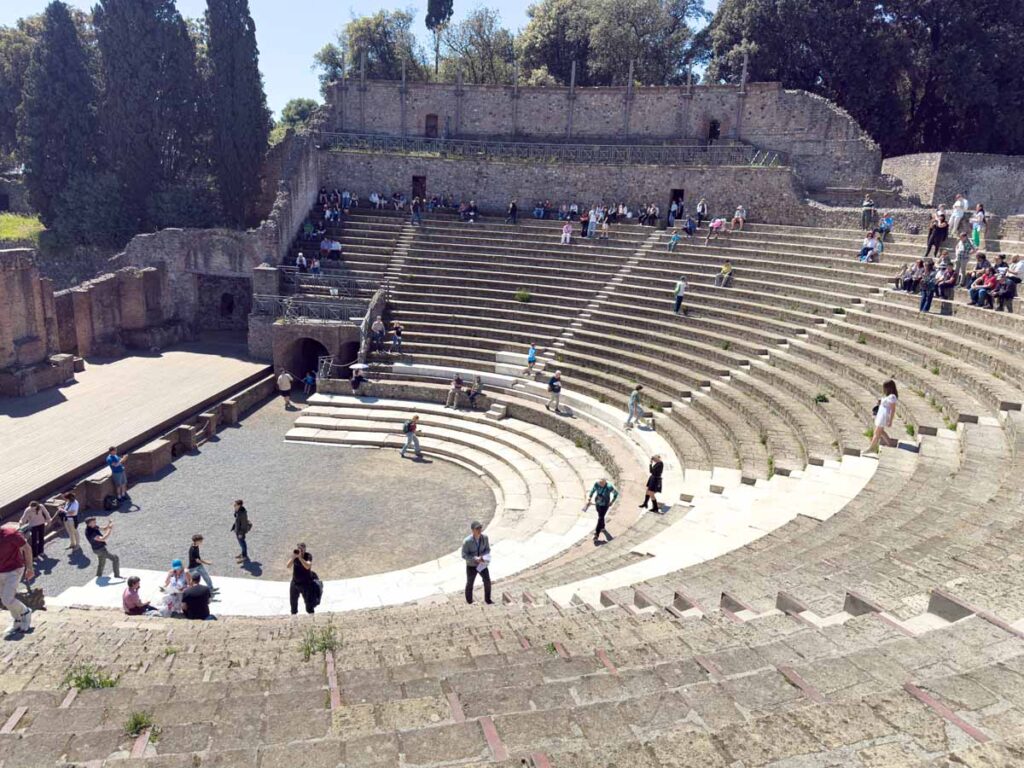
We then visited the Large Theatre, Pompeii’s biggest theatre, and saw original gladiator graffiti along the way. We loved seeing details like the graffiti, as they really brought home that Pompeii was a real city where people once lived.
Streets, Houses and Roman Chariot Tracks
As we walked through one of Pompeii’s main streets, we could still see grooves created by chariot wheels.
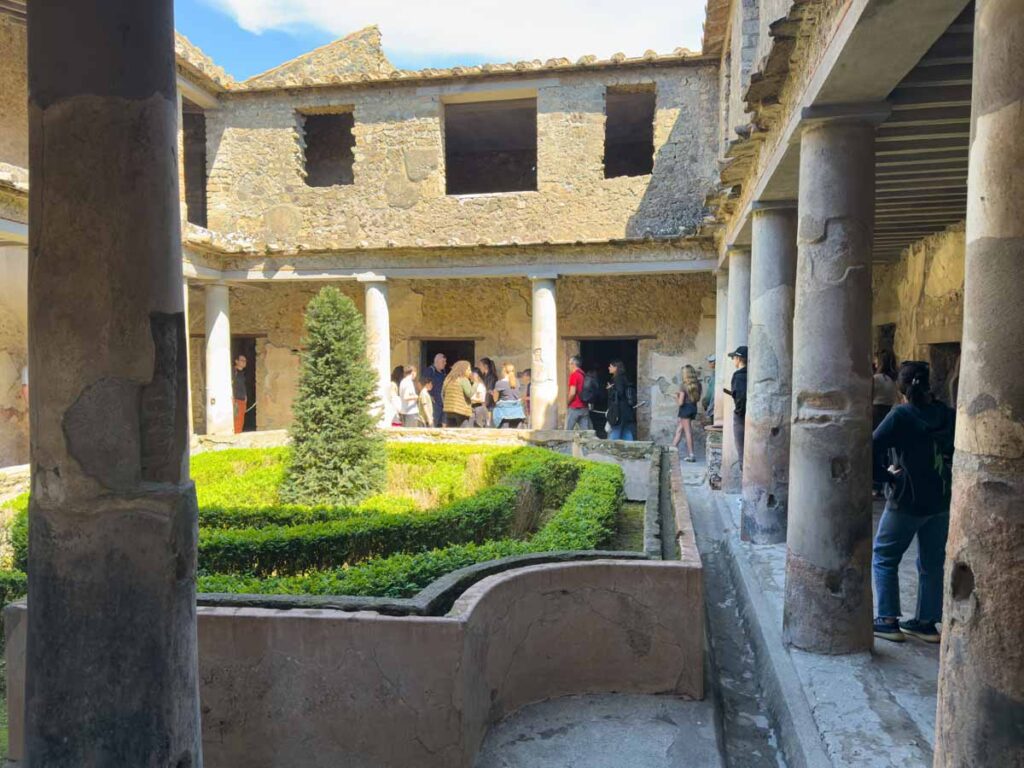
We also visited the remarkably well-preserved remains of three homes that had belonged to affluent families. Details including fountains, mosaics and elaborate artwork were still visible on the walls. Seeing these surviving details gave us a much clearer picture of daily Roman life than simply looking at stone foundations would have.
Seeing the Ongoing Excavations at Pompeii
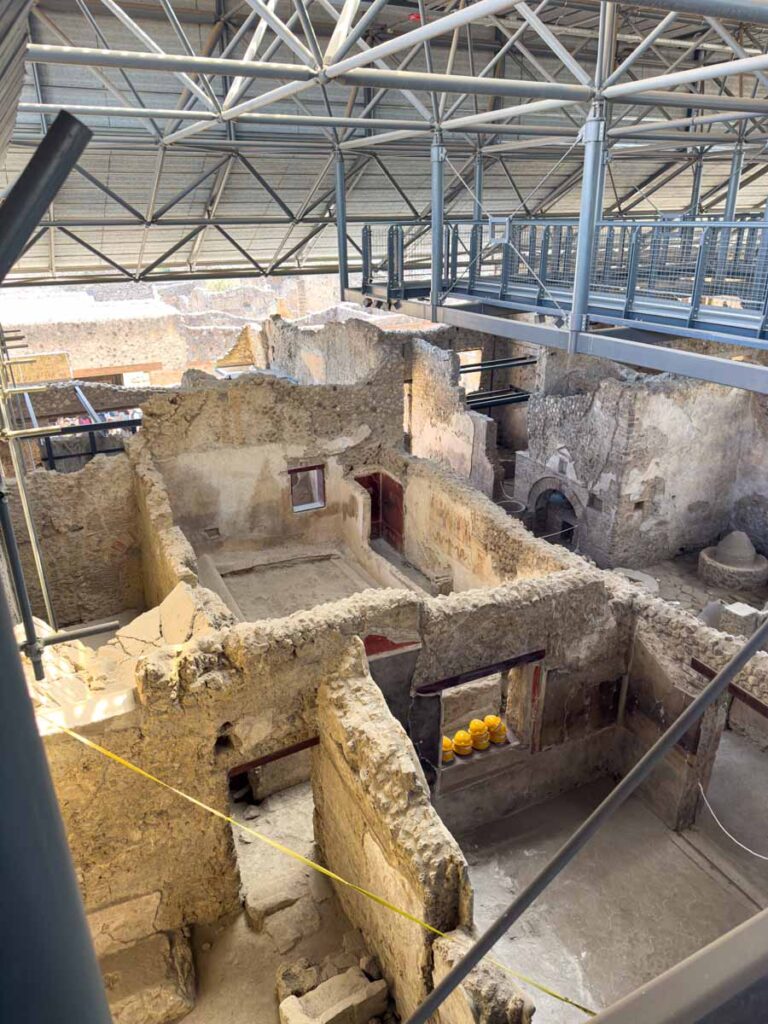
One of our favourite moments was watching archaeologists actively excavate another section of Pompeii. We could see structures in very different stages, from fully excavated buildings to others still roughly two-thirds full of volcanic ash.
Seeing the excavation process helped us understand how so much of Pompeii had survived for nearly 2,000 years. We then walked to an elevated viewpoint overlooking a large portion of the ruins, which reinforced just how large the ancient city was.
The Plaster Casts of Pompeii
Some of the most memorable parts of our visit were also the most difficult.
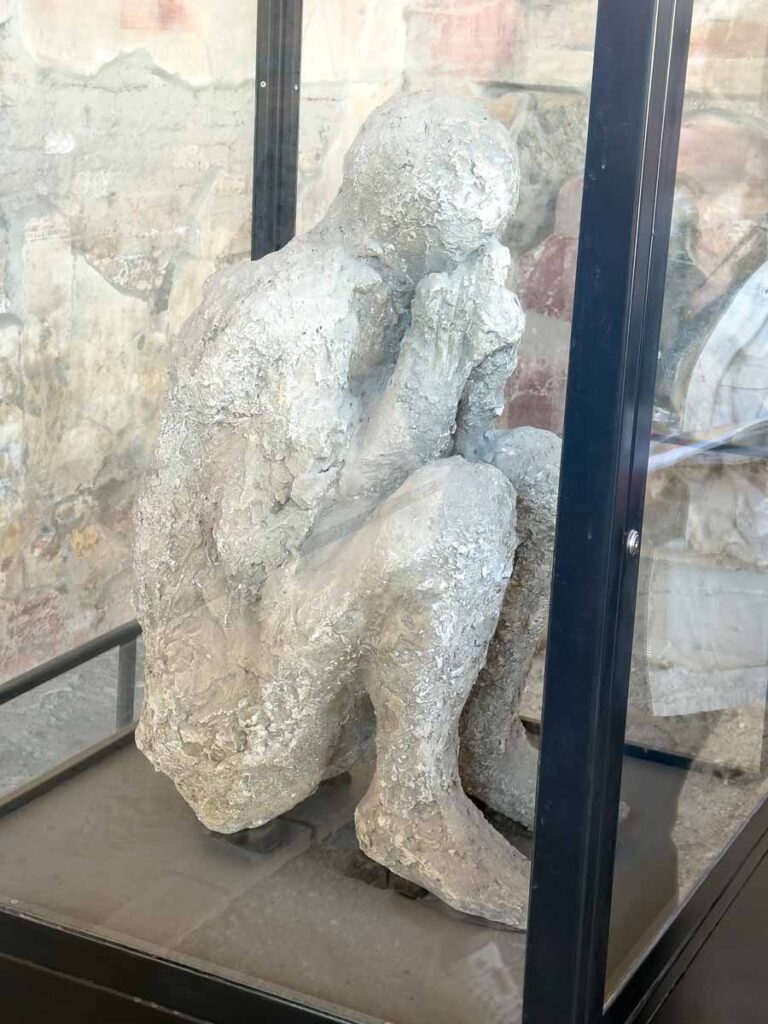
We first saw plaster casts of Pompeii’s victims near the bathhouse. Seeing the casts of people in the positions they were in during their final moments, including some with their faces covered or bodies lying on the ground, was sobering.
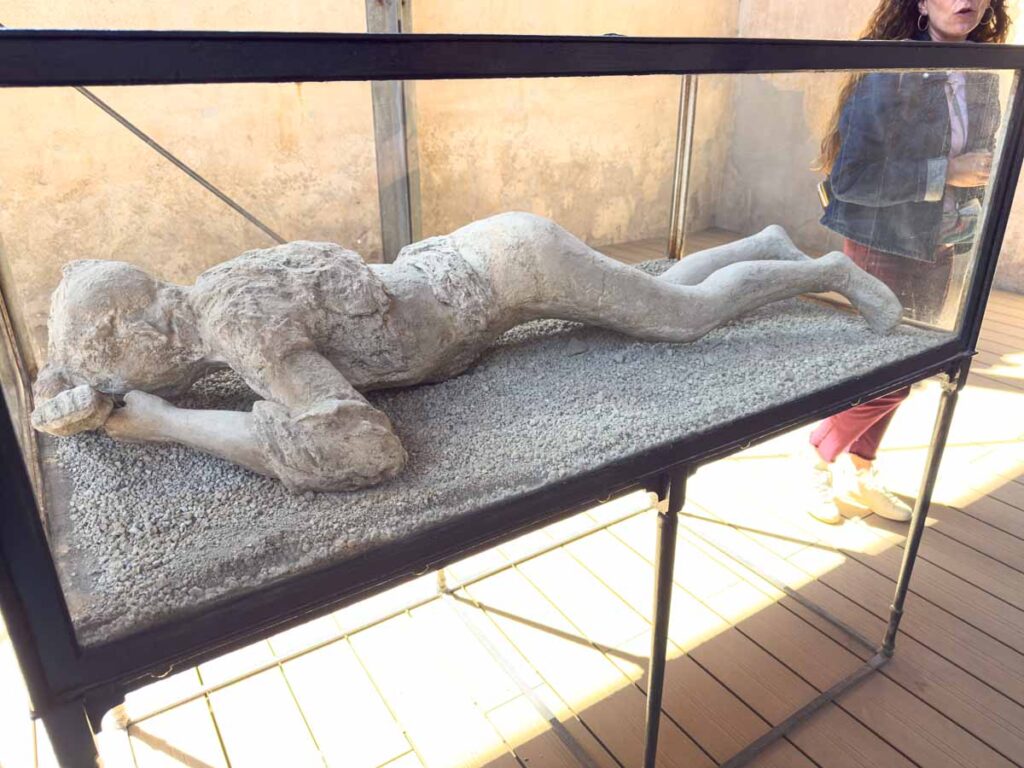
Our guide later took us into the Macellum, Pompeii’s ancient market area, where we saw several more casts. After our private tour ended, we made a final stop at the Antiquarium, which displays artifacts and statues along with additional plaster casts.
By the end of the visit, we were extremely impressed by Pompeii. It was considerably larger than we had expected, and having a private guide made a significant difference to how much we understood and enjoyed the experience.
Where to Stay Near Pompeii: Why We Chose Ercolano
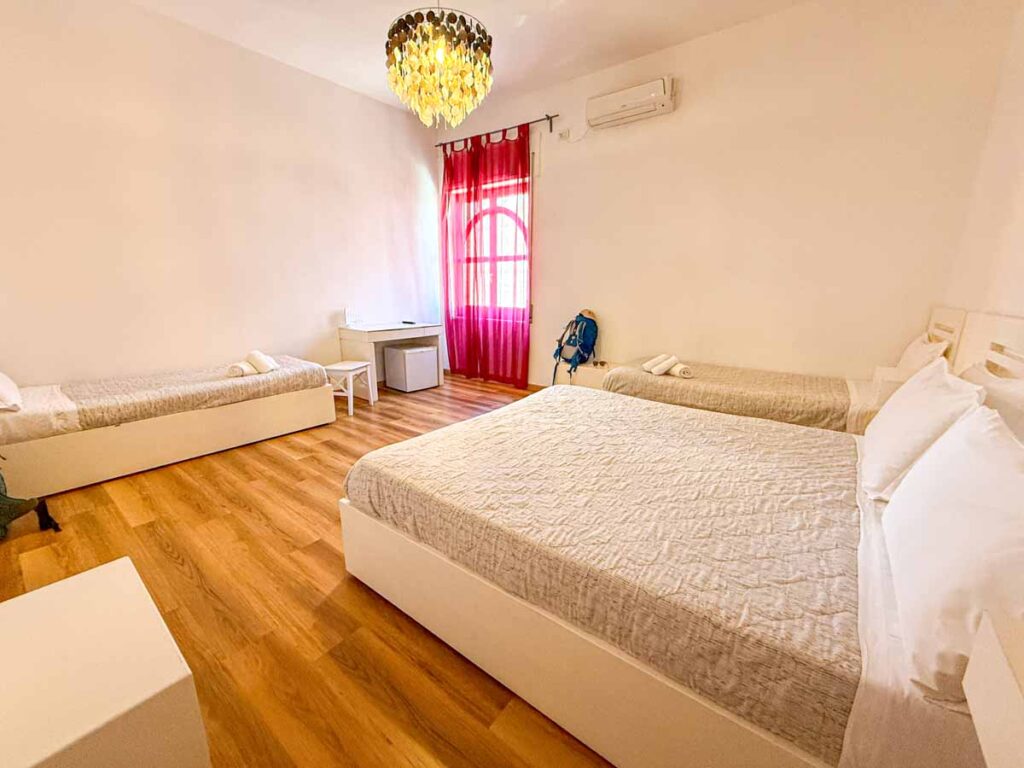
We stayed at Hotel Herculaneum in Ercolano, and its location worked very well for our trip. The Herculaneum archaeological site was on our doorstep, the meeting point for our Mount Vesuvius transportation was a short walk away, and Pompeii was a short train ride from Ercolano.
The hotel itself also worked well for us. Our room had a queen bed and two single beds, and the complimentary buffet breakfast offered a large selection of good-quality items.
Based on our experience, we do not recommend staying near the Pompeii ruins themselves. We did not find the area surrounding the Pompeii ruins appealing, and nearly every nearby restaurant we checked had very poor Google ratings. Unfortunately, we ate lunch at a coffee shop outside Pompeii and all four of us ended up with food poisoning, causing us to miss a day of our trip to the Amalfi Coast.
If you’re considering staying in Ercolano as a base for your visit to the Pompeii area, read our full Hotel Herculaneum review for a closer look at the rooms, breakfast, location and what it was like to stay there.
Is Pompeii Worth Visiting?
Pompeii was absolutely worth visiting for us, but combining it with Herculaneum and Mount Vesuvius made the experience much more meaningful and complete. Hiking the volcano first gave us context for what we later saw at both archaeological sites, while Herculaneum offered a smaller and remarkably well-preserved look at Roman life before we tackled the much larger ruins of Pompeii.
If we were making the same trip again, we would still spend the money on a private guide at Pompeii. We would also add an audio tour or guide at Herculaneum rather than exploring entirely on our own. Those were the experiences that helped turn the ruins from interesting ancient structures into places where we could better understand how people actually lived and what happened when Mount Vesuvius erupted.
More From Our Italy Trip
Our stops in the Pompeii area were part of a longer trip through Rome, the Bay of Naples and the Amalfi Coast. If you’re planning a similar itinerary, our other first-hand travel posts may help with the practical side of putting your Italy trip together.
We started with 24 hours in Rome before travelling south to spend three days on Ischia. After our three fun and active days on the island, we continued to Sorrento to explore the Amalfi Coast.
We had planned two full days in Sorrento, although one was lost to the food poisoning we discussed above. We made the most of our remaining day with a ferry trip along the Amalfi Coast, including stops in Amalfi and Positano.